Prefrontal Cortex
Directives
Sequences the assessment workflow, sets goals, and translates clinician intent into concrete next steps across the platform.
The first AI clinician with neuroanatomical mapping.
Six regions. Prefrontal Cortex, Broca's Area, Cingulate, Amygdala, Hippocampus, Cerebellum — each mapped to a distinct clinical capability. Not a chatbot. A brain built for psychological practice.

Every other clinical AI is a chatbot wrapper. Alix is built on a neuroanatomical map — each region of the brain mapped to a distinct clinical capability.
The way clinicians actually think.
Sequences the assessment workflow, sets goals, and translates clinician intent into concrete next steps across the platform.
Shapes language and clinical prose — adjusts voice to clinician, client, or report context. Reads like a colleague, writes like a clinician.
Surfaces what matters in the current session — flags conflicts, inconsistencies, and the signal hiding in noisy data.
Detects risk and severity markers in real time — acute risk language, red-flag patterns, urgent indicators across the assessment dataset.
Holds longitudinal context — prior assessments, score histories, treatment changes — and surfaces them when relevant to the current session.
Coordinates timing across batteries, eAssessments, and templates — the connective tissue that keeps the whole pipeline moving smoothly.
Workflow. Advisor. Research. Alix adapts to what you need in the moment — and the audit trail records every interaction.
Your in-platform guide. Alix helps you navigate ADMRL, explains features, and walks you through how to use every part of the system.
Alix walks you through the report builder step by step, explaining how to select sections and tailor AI prompts to build a completely custom report template for your needs.
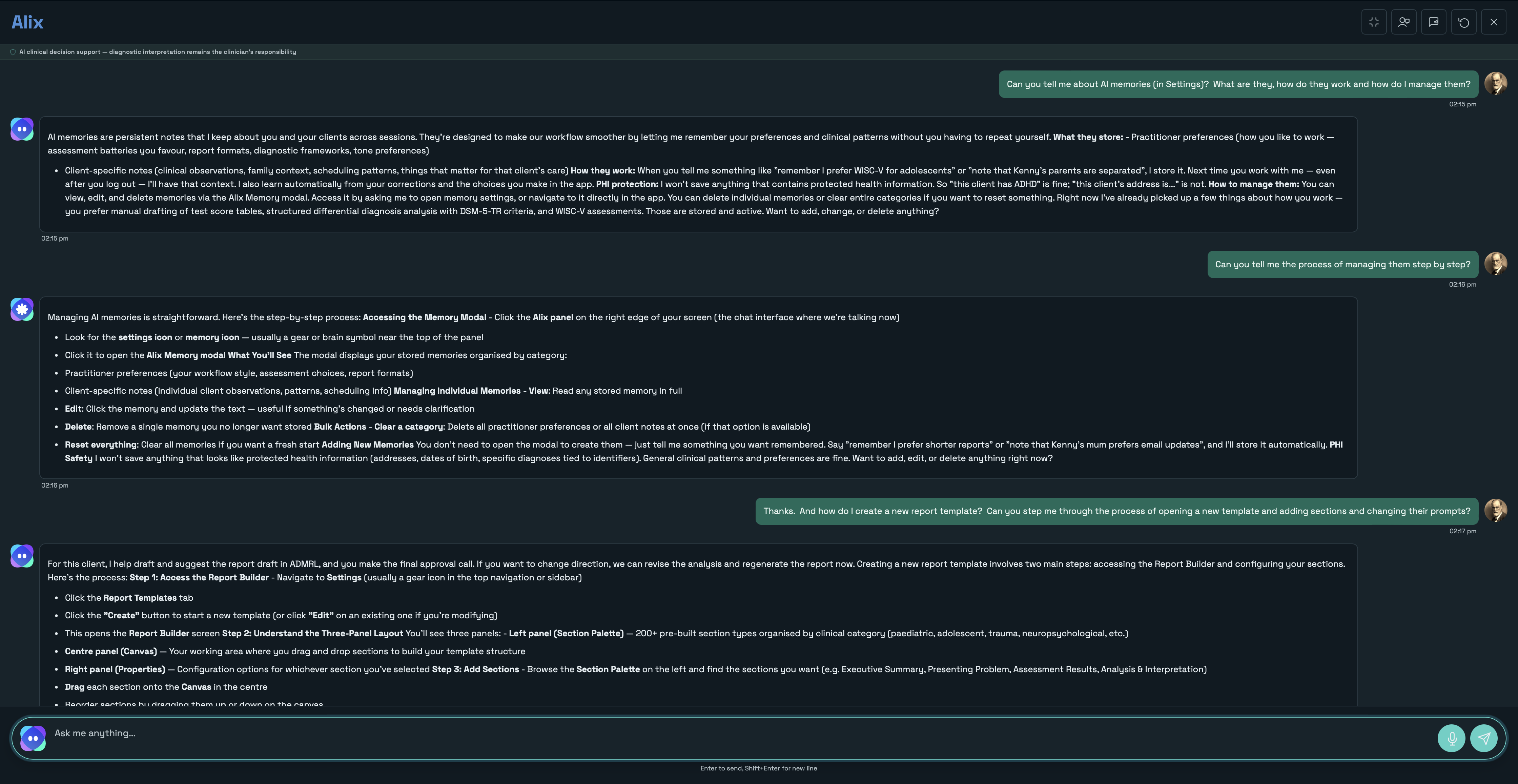
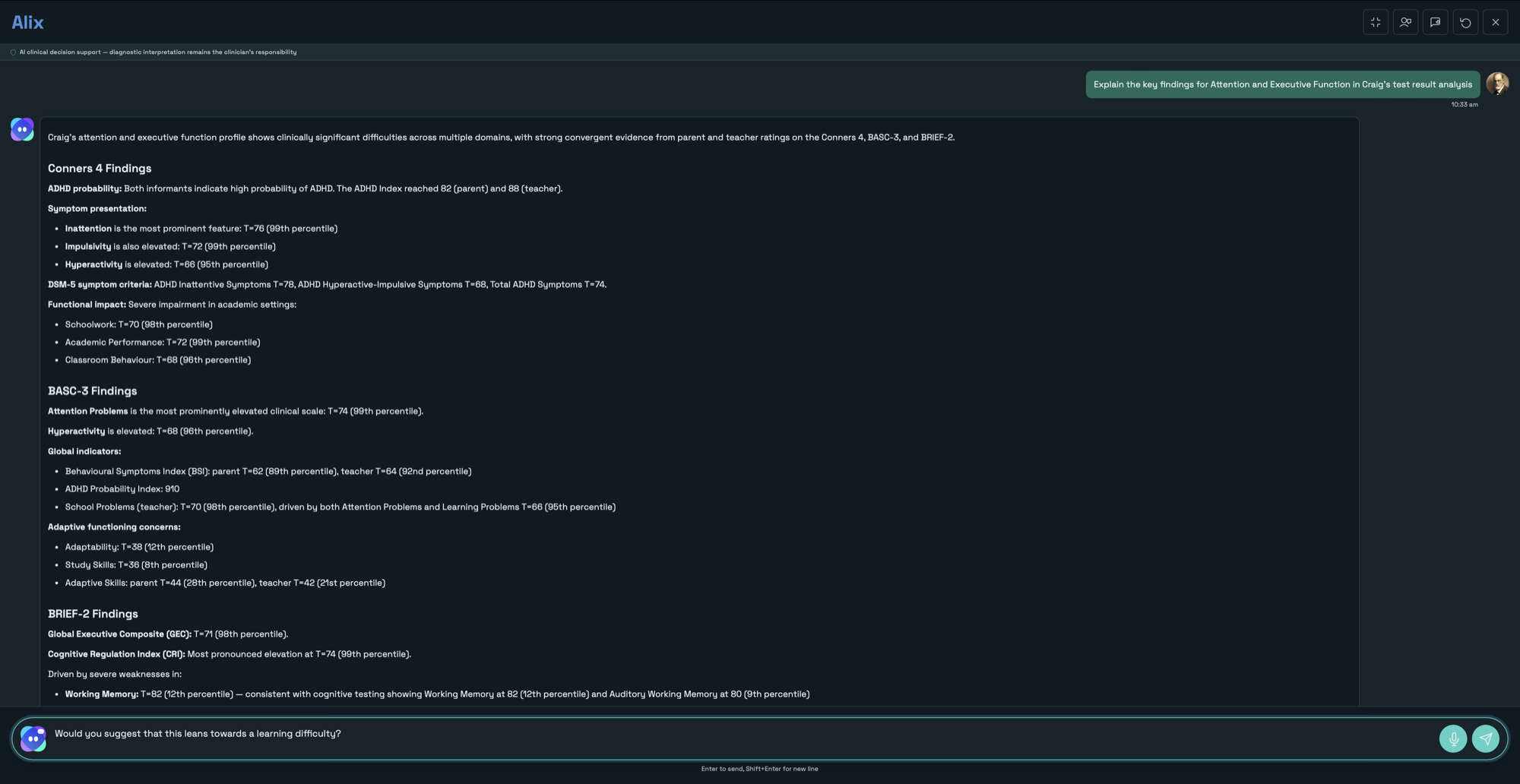
Per-case clinical reasoning. Ask about a specific client and Alix summarises score patterns, references published norms, and surfaces considerations for clinician review.
Alix returns a structured summary of FSIQ scores and percentiles, domain-level trends, potential masked weaknesses in balanced profiles, and confidence-interval caveats for clinician review.
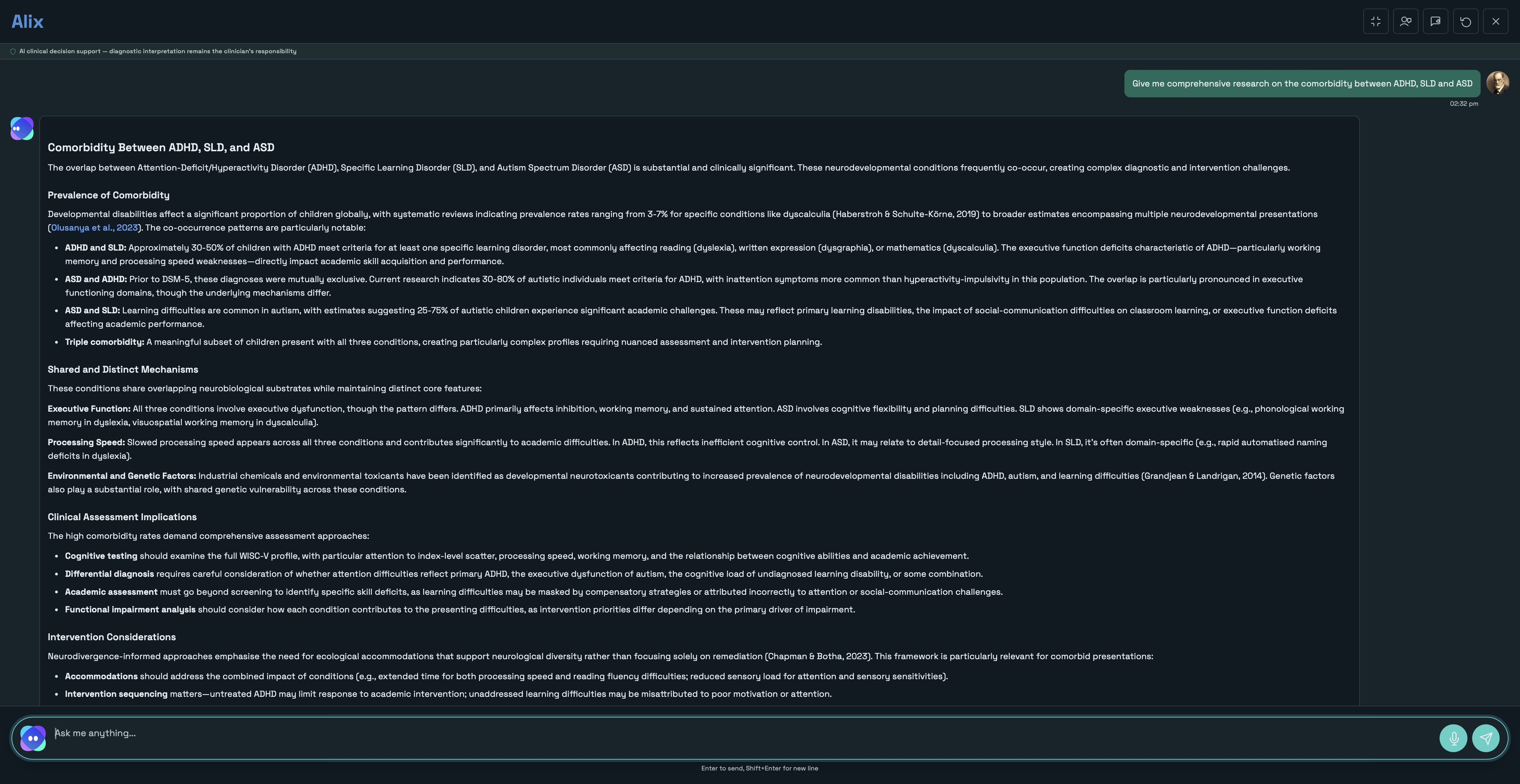
MCP-powered evidence retrieval. Alix searches current clinical literature and returns findings with clear source provenance and a reminder to verify against primary sources.
Alix returns dated research findings with co-occurrence rates, shared cognitive profiles, and clinical implications — with a source currency note and recommendation to verify against primary sources.
Every other AI markets what it can do. Alix is explicit about what it won't — because clinician authority isn't a feature. It's the architecture.
Alix adapts expression to the clinical moment. Not a static avatar — a face that responds the way a colleague would.

Celebrating clinical wins or positive progress.

Concentrated during active workflow execution.

Careful when discussing clinical uncertainty.

Attentive during clinical consultation.

Thoughtfully analyzing data and generating insights.

Warm when you need professional reassurance.
The differentiated technical foundation — not the table-stakes LLM features.
Alix knows your active client, current assessment, and the workflow actions available right now.
Facial expressions and tone that adapt to clinical context — not a static chatbot.
Every interaction logged, timestamped, available for clinical review and AHPRA compliance.
At every step. Accept, modify, or reject any suggestion. The clinical decision stays yours.
Start your free trial and put Alix to work — full access, no waitlist, and a direct line to the team.
Start Free Trial →